


January 21st, 2026, 7:00 pm - 8:15 pm
The recording is at https://youtu.be/hw9gA9xXYz4.
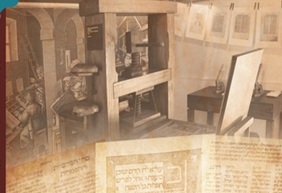 The appearance of printing technology in the Jewish world was far more than a technical revolution—it was a spiritual and cultural upheaval that reshaped the foundations of Jewish life. For a people whose existence was bound to the word, the book, and the unbroken chain of learning, the printing press became not merely an instrument of replication but a vessel of survival. It multiplied Torah where exile had scattered it, preserved voices that might have vanished amid the turbulence of history, and gave permanence to the fragile beauty of written tradition.
This presentation is a visual and historical journey into this creative moment, centered on the brief yet extraordinary story of Hebrew printing in Portugal. Between 1487 and 1496—spanning Faro, Lisbon, and Leiria—three Hebrew printing houses flourished, producing a body of work that accounted for nearly two-thirds of all printing in Portugal during that decade. The story begins with the Pentateuch printed in Faro in 1487, the first book printed in Portugal in any language, and concludes with the Almanach Perpetuum of R. Abraham Zacuto in 1496, the first scientific book printed in the land.
Ultimately, this presentation invites the audience to rediscover a remarkable flowering of faith and intellect before the shadow of expulsion fell. It is both a tribute to the enduring brilliance of Iberian Jewry and an invitation to rediscover monuments not made of stone, but of paper and parchment.
This presentation is based on the new book: Monuments of Paper and Parchment – Hebrew Printing in Portugal in the Late 15th Century by Rabbis Shlomo Pereira and Eli Rosenfeld.
 Rabbi Shlomo Pereira was born in Lisbon and received his Ph.D. in Economics from Stanford University. He joined the faculty of the University of California, San Diego in 1987 and from 1995 until his retirement in 2025, he served as Thomas Vaughan Professor at the College of William & Mary. His primary interests were in public economics, specifically taxation, infrastructure policies, and environmental issues. Ranked among the top 5% of economists in the world, he authored 136 refereed technical research articles published in international journals and 10 policy books.
Rabbi Pereira received his rabbinical ordination in Jerusalem in 2004 and has served in the last two decades as assistant rabbi and education director at Chabad of Virginia. He has taught extensively on topics ranging from Jewish history and law to Jewish philosophy and mysticism. He is the author of two widely circulated texts, Hadrat Melech and Chachmei Halacha, on the history of the Jewish legal tradition, and for the last five years, he has circulated a weekly historical note on the continuing Jewish presence in the Land of Israel, Jewish Moments in the Land of Israel.
Rabbi Pereira’s current research focus is on early Sephardic history. In collaboration with Rabbi Eli Rosenfeld he has published several bilingual (Portuguese and English) books: in 2018, Jewish Voices from Portugal, a book of sermons on the Torah portion based on the writings of rabbis who called Portugal home in the late 1400s; in 2020, Jewish Ethics from Portugal, focusing on the commentaries of the same rabbis on Pirkei Avot; and, in 2025, Monuments of Paper and Parchment, a volume on the history of early Iberian Hebrew printing. He is currently working on several research projects on different specific aspects of early Hebrew printing as well as on the early Sephardic diaspora.
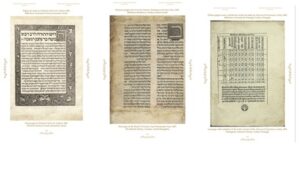
Samples of early Hebrew printing:
Copyright © 2026 Jewish Study Center. All rights reserved. Website designed by Addicott Web.